
LEARN / THE BALANCE FRAMEWORK
Read the structure.
Understand the context.
A seven-step learning path: understand the map, choose your view, read the response, and bring the ideas together in a complete chart read.
Educational chart reading, not trade signals. Futures trading involves substantial risk; no zone or pattern guarantees an outcome.
New to the name? AMT Balance and Auction Market Theory explained →
STEP 1 / 7
Understand the map
Start with the references before interpreting the movement. “Balance” means the reference on your selected view: 12B, Zone Balance, Daily Balance, Weekly Balance, or another view. General examples do not assume everything is Daily Balance.
Balance is a reference, not a signal
Balance gives you a consistent reference for reading price within a chosen timeframe. Instead of asking only whether the last candle was up or down, ask where that movement sits relative to Balance and the surrounding zones.
The Balance zone is an area to observe, not proof that every participant agrees on value. Price can cross it repeatedly, pause there, or move away from it. Its usefulness comes from organizing those observations—not from promising that price must return.
Walk through an example
Hypothetical example. A rally back toward Balance on your selected view after a selloff is not automatically a new uptrend. It may still be a recovery inside a larger downward move.
Price moves down through Balance on the selected view. Start with the sequence already visible.
Locate price first. Decide what its behavior means second.
Read the zones as a map
The chart separates the central Balance area from upper and lower reference zones. The labels describe location within the selected timeframe. They do not establish an entry, a stop, or a guaranteed destination.
Price can move through the space between zones. Keep the next relevant area in view without assuming the whole journey will occur.
- Balance zone: the area between Balance High and Balance Low, with the Balance reference inside it. Watch whether price is moving back and forth or beginning to hold outside.
- Upper Dyno zone: the area between R1 and R2. Observe whether an upward move pauses, returns inward, or continues beyond the area.
- Lower Dyno zone: the area between S1 and S2. Observe whether a downward move pauses, returns inward, or continues beyond the area.
- Outer references: further levels provide additional context after an extension. Reaching one is an observation, not a required reversal.
Plain-English glossary: similar names, different meanings
- Balance
- The central reference on the view you selected. It is not automatically Daily Balance.
- Balance zone
- The area between Balance High and Balance Low. Distinguish this area from the Balance reference inside it.
- Zone Balance
- The named Zone view/reference in AMT. Do not confuse that name with the generic Balance zone described above.
- Upper / lower Dyno
- The reference areas above and below Balance. A test can lead to a return inward or a move beyond the area.
- Developing Balance
- A developing reference that can change while its relevant period unfolds. Identify it separately from completed-period references.
- Next Balance
- The next displayed Balance reference along the map you are reading—not automatically Developing Balance or a higher timeframe.
A zone tells you where to pay attention; it does not tell you what must happen.
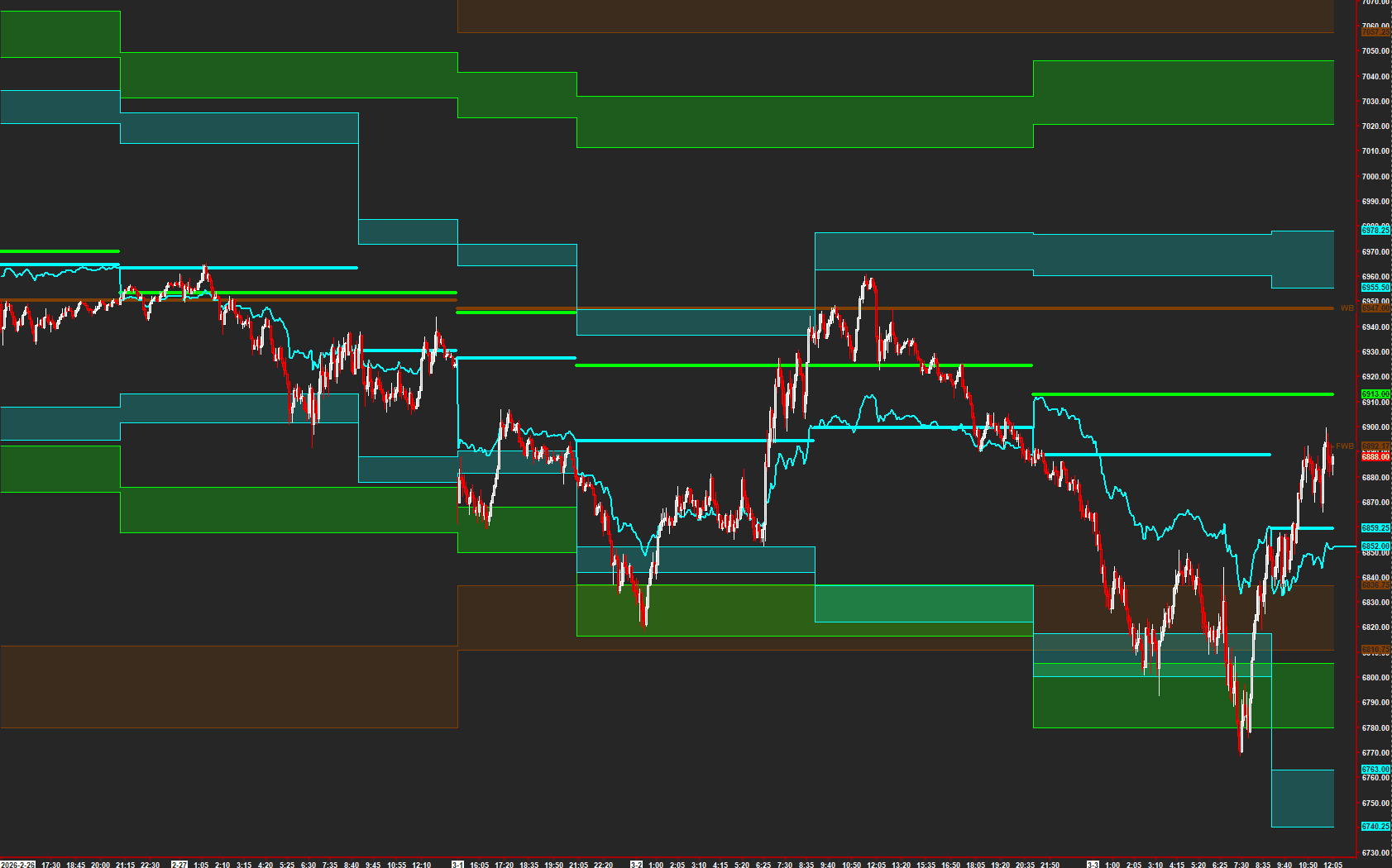
Read a real AMT chart
Connect the schematic to the actual display. Use the numbered notes to identify references and observe price; these markers are not entries.
A FIRST READ
Locate price
Start with the horizontal references and the colored areas around them. Find Balance for the timeframe you are reading before deciding where price sits in the bigger picture.
An actual chart example. The animated hero chart uses illustrative data.
BEFORE YOU MOVE ONIs Zone Balance the same label as the Balance zone?
No. Zone Balance names a particular view/reference. The Balance zone describes the area between Balance High and Balance Low. Read the chart label before interpreting the reference.
STEP 2 / 7
Choose your view
Read from the broader context inward
AMT provides several timeframe views, including Scalp, Daily, Weekly, Monthly, Quarterly, Yearly, 4B, 12B, and Zone. You do not need every view on screen. Start with a broader context and a smaller working view that suit the question you are studying.
The broader view identifies nearby structure and potential obstacles. The working view shows the sequence unfolding within it. Do not switch to a different timeframe simply to keep a preferred interpretation alive.
- Mark the broader Balance and nearby boundaries.
- Locate the working timeframe inside that larger map.
- Notice overlapping references, but do not treat them as independent evidence of a guaranteed reaction.
- If the views conflict, describe the conflict rather than forcing agreement.
Walk through an example
Hypothetical example. Price is above Daily Balance but approaching a Weekly upper area. The local move is upward; the larger map supplies an area to observe. Neither observation cancels the other.
The central reference belongs to the daily view. The upper reference belongs to the weekly view.
ILLUSTRATIVE LABEL-READING EXAMPLE
Name the view before the level
- Selected view
- 12B
- Reference being observed
- Balance
- Journal wording
- “Price is returning toward 12B Balance.”
This is a reading aid, not a platform screenshot. If your chart says Zone, Daily, or Weekly, use that label instead. Check the study settings when the label is unclear; do not infer the view from its color or position.
A local rally and a broader downward context can both be true.
BEFORE YOU MOVE ONA line sits above price. Does that make it Weekly Balance?
No. Position and color do not identify a view. Confirm the displayed label and study settings, then record both the view and the reference.
STEP 3 / 7
Read the response
Separate location, evidence, and execution
A useful chart read has three distinct parts. Location identifies the area being tested. Evidence describes what price does there. Execution belongs to a separately defined and tested trading plan.
In this guide, acceptance means observable persistence on one side of a reference, such as continued trading or a held retest. Rejection means an attempt that returns away from the area. These are descriptions, not universal rules about a particular number of bars.
Define the observation window before reviewing the outcome. Otherwise it is easy to change the meaning of acceptance or rejection after seeing what happened.
- Location: which zone and which timeframe?
- Evidence: what has actually happened since the test?
- Invalidation: what would contradict the current interpretation?
- Execution: does the situation meet your own tested rules, or is waiting the appropriate choice?
Do not turn a useful location into an automatic trade.
Rotation and extension tell different stories
Rotation describes movement back through an established area or toward Balance. Extension describes movement outward beyond a reference area. These are useful ways to describe a sequence, rather than rigid labels for every candle.
A market can rotate on a smaller timeframe while continuing an extension on a larger one. A pullback therefore needs context: it could be a pause within continuation, or the beginning of a return through the range.
Watch the response after a boundary is tested. Returning inside weakens the case for sustained movement beyond it. Remaining outside and holding a later retest offers different information. Neither guarantees the next move.
Walk through an example
Hypothetical example. Price briefly trades above an upper zone, then returns inside. Record it as a failed attempt to remain outside—not a confirmed continuation just because a new high printed.
Price rises from the central area. Location tells you where to observe, not which trade to take.
The behavior after a test matters more than the touch alone.
Same test. Two possible outcomes.
The first eight candles match. After the upper-Dyno break, one retest holds and the other returns inside. Open both examples and use the same numbered step to compare them. Only one narration plays at a time.
A / The retest holds
Price starts moving outward from the central reference. Follow the sequence without assuming a destination.
B / The break fails
This example begins with the same move away from Balance as the continuation example beside it. Nothing in the starting path guarantees the later outcome.
BEFORE YOU MOVE ONBoth charts broke upper Dyno. What separates their later reads?
The response after the break: one holds outside and extends; the other returns inside and rotates inward. The initial break alone does not decide which path follows.
STEP 4 / 7
Follow the movement
Follow Balance → Dyno and Dyno → Balance as possible sequences on your selected map, not guaranteed destinations.
Watch: Balance → Dyno → Balance
In this framework, Balance is a starting reference for studying how a directional move develops. Follow the move from Balance toward upper Dyno here, or toward lower Dyno in a downward move. Not every departure becomes a trend.
Use the two-wave idea as a sequence
One sequence to study is an initial move away from Balance, a pullback, and a further attempt in the original direction. Describing the first push and the later attempt can help you avoid treating every upward or downward candle as a fresh setup.
The pullback is the important question: does it preserve the earlier structure, or undo it? A later push can continue, stall short of the previous extreme, or fail outright. Markets are not required to complete two waves, and the label should not override conflicting evidence.
Watch: first push, pullback, second attempt
The first upward push leaves Balance and reaches upper Dyno. This is the first wave in the illustrated sequence, not proof that a second wave must follow.
Compare: when the second wave fails
The first push leaves Balance and reaches upper Dyno. This beginning matches the successful two-wave illustration, so the first push alone cannot tell us which outcome follows.
Track what survives the pullback, not just what number you give the wave.
BEFORE YOU MOVE ONDoes naming a second wave mean price must exceed the first extreme?
No. A second attempt can stall or fail. Observe what survives the pullback and revise the interpretation when the structure changes.
STEP 5 / 7
Understand extension
A hold beyond upper or lower Dyno shifts attention toward the next displayed Balance and Dyno references. “Next” describes the map you are reading—not an automatic move to a higher timeframe.
Watch: break upper Dyno → next Balance and Dyno
Start at Balance and follow the upward move toward upper Dyno. In this simplified map, the next displayed Balance and Dyno references sit above it. Confirm the actual labels and order on your own chart.
Watch: break lower Dyno → next Balance and Dyno
Start at Balance and follow the downward move toward lower Dyno. The next displayed Balance and Dyno references are below in this simplified example. Use the actual references on your selected map.
Keep extension readings in context
If you display Point Break, treat it as a supporting reference while reading the surrounding structure. It does not replace the zone map, price behavior, or the timeframe you selected.
A move that looks stretched can continue. A quieter reading does not guarantee that a new move is about to begin. Avoid using a display value alone to justify fading a trend or chasing a breakout.
Optional supporting lesson. Understand the map and price response first; Point Break does not replace them.
Extension is context—not a countdown to reversal.
BEFORE YOU MOVE ONAfter a Dyno break, is the next Balance a guaranteed destination?
No. A move can pause, reverse, or fail before reaching it. Observe whether price stays outside, and reassess if it returns inside.
STEP 6 / 7
Changing references
Treat forward references as developing context
Forward references show developing structure while the relevant period is still incomplete. They can change as that period unfolds. Keep them visually distinct from completed-period references when the chart offers that choice.
A developing level is not a promise of where price will travel. It is also not information you could necessarily have known earlier in its final form. For a fair review, save what the chart showed at the time of the decision instead of judging an earlier decision only against the finished chart.
Watch: where Developing Balance fits
The solid line marks Balance for this example. The dashed line marks Developing Balance. Keep their labels separate: Developing Balance can change while its relevant period is still unfolding.
Separate what was known then from what became visible later.
Time changes the reference map
Support and resistance in a timeframe-based framework are not permanent horizontal prices. When the relevant period changes, the reference map can change too. A location that mattered in the previous period may have a different role in the new one.
Compare where the previous period finished with where the new period opens relative to the current references. Distinguish a change in the map from a fresh price move through an unchanged level.
Use consistent session settings, time zones, and instrument data when reviewing examples. Different chart settings can make two apparently similar screenshots describe different contexts.
Walk through an example
Hypothetical example. A new week begins with price near a newly displayed reference. Do not call it a breakout of last week’s level without checking which reference belongs to which period.
Read price against the reference that belongs to the ending week.
At a period change, reassess the map before carrying an old conclusion forward.
BEFORE YOU MOVE ONCan you use the final Developing Balance position to explain an earlier decision?
Not unless that position was actually visible then. Save or replay the decision-time view, and distinguish a changing reference from a fresh price move.
STEP 7 / 7
Put it together
Build a repeatable preparation routine
Use the same questions before each review. The objective is not to predict every move, but to make your reasoning visible and consistent. A chart map supports a trading plan; it does not replace one.
- Context: which instrument, session, and timeframes am I reading?
- Location: where is price relative to Balance and the nearest zones?
- Sequence: is price moving inward, extending outward, or undecided?
- Alternatives: what would support continuation, and what would support a return?
- Invalidation: what observation would make me revise the current read?
- Risk: does my tested plan define acceptable exposure and an exit? Stops can slip; a planned risk limit is not a guaranteed fill.
- Review: save the chart and the reasoning before seeing the outcome.
Prepare more than one possible outcome. Do not force a trade.
Put the entire read together
Follow one fictional sequence from context and reference selection through the price response, an alternative outcome, and the final journal observation. This is a chart-reading exercise, not a complete trading strategy.
Watch: a complete chart read, start to finish
Begin by naming the instrument, session, and selected Balance view. This chart is fictional and uses a generic view. Locate Balance, upper Dyno, and lower Dyno. On your actual chart, also check the broader view and any Developing Balance before interpreting the local move.
Common mistakes to catch early
Most chart-reading errors begin when an observation quietly becomes a certainty. Keep the description of what has happened separate from your expectation of what might happen next.
- Buying or selling solely because price touched a zone.
- Calling every move outside Balance a lasting trend.
- Ignoring nearby higher-timeframe structure.
- Treating several related levels as independent proof.
- Using the final developing levels to explain an earlier decision.
- Changing the timeframe or invalidation rule after the original idea fails.
A clear reason to wait is a useful outcome of analysis.
Practice before opening the explanation
For each hypothetical scenario, name the view, describe the evidence, and state what would change your interpretation. Then compare your answer with the notes.
Price tests the upper area and returns inside
Price rises from the central area. Location tells you where to observe, not which trade to take.
- What you can say
- The attempt to stay outside has not held. Rotation back through the current area is one possibility to observe.
- What to observe next
- Does the return persist, or does price reclaim the boundary? Check the broader timeframe before treating this as a reversal.
- What to avoid
- Assuming an upper-zone touch is automatically a short trade.
Price leaves Balance and holds a retest
Price starts moving outward from the central reference. Follow the sequence without assuming a destination.
- What you can say
- The sequence is consistent with an outward move. The retest supplies new evidence beyond the first break.
- What to observe next
- Observe the next reference area and what would invalidate the hold. There is no requirement for price to reach that next area.
- What to avoid
- Calling continuation certain or chasing after the planned entry has passed.
The smaller view rises into broader resistance
The central reference belongs to the daily view. The upper reference belongs to the weekly view.
- What you can say
- A local upward move is meeting a reference from a larger timeframe. This is conflicting context, not a broken chart.
- What to observe next
- Describe which timeframe each observation belongs to. The smaller move may pause, reverse, or continue through the larger reference.
- What to avoid
- Switching timeframes until the chart agrees with your preferred direction.
Check your understanding
Price touches Balance. Is that an entry signal?
No. It identifies a location. You still need observable behavior, a defined invalidation, and the entry and risk rules of your own tested plan.
Can a daily rotation happen inside a weekly extension?
Yes. The labels describe different timeframes. Read the smaller sequence within the broader context rather than treating the descriptions as mutually exclusive.
A developing level looks perfect on the finished chart. Was it available earlier?
Not necessarily. Developing references can change. Review a saved chart or replay from the decision time to avoid using information that was not yet available.
Review the decision, not only the result
Use replay or observation to practice before relying on a new interpretation in live trading. Pause at a zone test and write down the current context, the evidence you can see, and what would change your mind. Then reveal the next part of the chart.
Keep examples that disagree with your expectation as well as those that fit. A favorable result does not prove a good process, and one failed example does not by itself disprove a repeatable method.
When consulting research, check its market, session, sample, and event definition. A historical frequency of reaching a level is not a trade win rate; it does not include an entry, exit, fees, or slippage unless the study explicitly says so.
Your journal prompt
Instrument / session → selected view → reference tested → observed response → alternative outcome → what changed → screenshot from the decision time.
Include no-trade observations and failed ideas, not only examples that worked out.
A useful journal records context, alternatives, and invalidation—not just profit or loss.
BEFORE YOU MOVE ONWhat should you record if the chart has context but your tested entry setup is absent?
A no-trade observation: the selected view, references, evidence, alternatives, and what would change the read. Chart context alone is not an instruction to enter.