
AMT Delta Momentum
Normalized delta oscillator with dynamic OB/OS bands
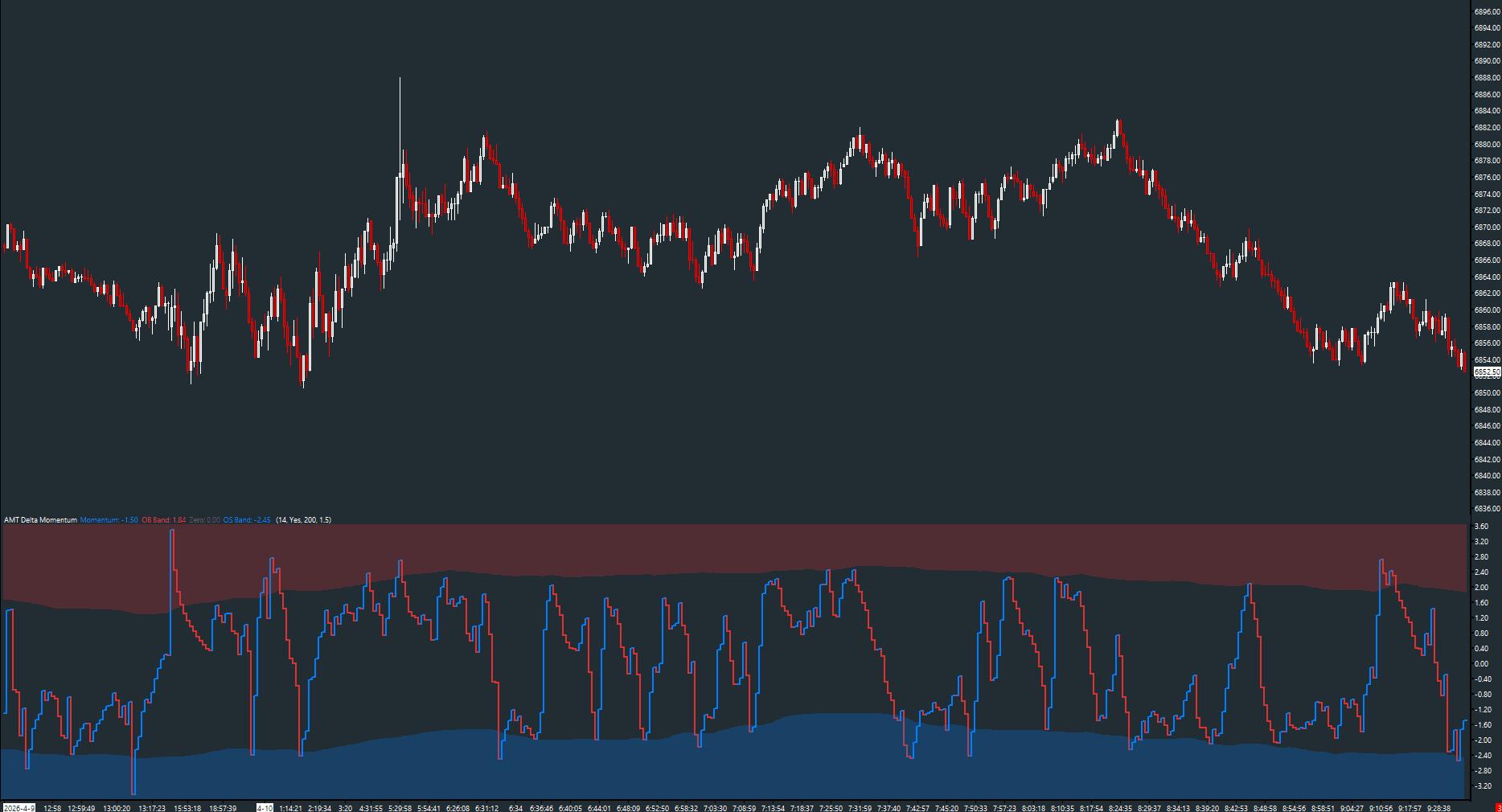
Computes cumulative volume delta (CVD) internally, normalizes it via rolling Z-Score, and displays it as a stair-step oscillator with dynamic Bollinger Band overbought/oversold zones. Captures the momentum of order flow in a mean-reverting, statistically normalized view.
The Concept
Raw CVD values are hard to interpret because they grow unbounded and vary dramatically across instruments and sessions. Delta Momentum normalizes CVD into a stationary oscillator that fluctuates around zero, making overbought/oversold analysis meaningful regardless of the instrument or time of day. Adaptive bands provide dynamic thresholds that adjust to the oscillator's recent behavior, so extreme readings are always relative to current conditions.
How to Read It
The stair-step oscillator fluctuates around zero with dynamic OB/OS bands.
- Rising oscillator (auto-colored blue) = CVD is accelerating above its recent mean — bullish momentum
- Falling oscillator (auto-colored red) = CVD is decelerating below its recent mean — bearish momentum
- Touching the OB Band (red fill) = delta momentum is statistically extreme to the upside
- Touching the OS Band (blue fill) = delta momentum is statistically extreme to the downside
- Mean reversion from bands often precedes price reversals
Practical Tips
Smoothing Length (default 14) controls the lookback window — shorter is more responsive, longer is smoother. Session Reset (default Yes) restarts the calculation each session — disable for multi-day analysis. Band Length and Band Sensitivity control the adaptive thresholds — tighter sensitivity flags more extreme readings. The oscillator works best as a divergence tool alongside price.
Input & Settings
| No. | Input Name | Function |
|---|---|---|
| 1 | Smoothing Length | Rolling window for the Z-Score calculation. Default: 14. Range: 2–1000. |
| 2 | Session Reset | When enabled, resets CVD accumulation at the start of each trading session. Default: Yes. |
| 3 | Band Length | Lookback period for the Bollinger Bands on the Z-Score oscillator. Default: 200. Range: 10–1000. |
| 4 | Band Sensitivity | Standard deviation multiplier for the Bollinger Bands. Lower = tighter bands. Default: 1.5. Range: 0.5–5.0. |
Rolling window for the Z-Score calculation. Default: 14. Range: 2–1000.
When enabled, resets CVD accumulation at the start of each trading session. Default: Yes.
Lookback period for the Bollinger Bands on the Z-Score oscillator. Default: 200. Range: 10–1000.
Standard deviation multiplier for the Bollinger Bands. Lower = tighter bands. Default: 1.5. Range: 0.5–5.0.
Subgraphs
| No. | Subgraph Name | Function & Comments |
|---|---|---|
| 1 | Momentum | Default: Stair Step. Normalized CVD Z-Score oscillator, auto-colored by slope — blue when rising, red when falling. |
| 2 | OB Band | Default: Transparent Fill Rectangle Top. Upper Bollinger Band marking overbought zone. Red. |
| 3 | Zero | Default: Dash. Zero reference line separating bullish and bearish momentum. |
| 4 | OS Band | Default: Transparent Fill Bottom. Lower Bollinger Band marking oversold zone. Blue. |
Default: Stair Step. Normalized CVD Z-Score oscillator, auto-colored by slope — blue when rising, red when falling.
Default: Transparent Fill Rectangle Top. Upper Bollinger Band marking overbought zone. Red.
Default: Dash. Zero reference line separating bullish and bearish momentum.
Default: Transparent Fill Bottom. Lower Bollinger Band marking oversold zone. Blue.
Free with the AMT Toolkit
This study is part of the AMT Toolkit — a free collection of Sierra Chart studies for orderflow, market structure, and chart utilities. 100% free, with no AMT Gold membership or credit card required.
Sierra Chart and applicable market-data fees are separate.
Get the AMT Toolkit — Free