AMT Dual Stochastic RSI
Two-layered stochastic analysis for short-term and long-term momentum
Integrates two Stochastic oscillators to provide a comprehensive view of market momentum. The dual approach offers a layered perspective on potential price movements, with overbought/oversold zones and signal crosses indicating trading opportunities.
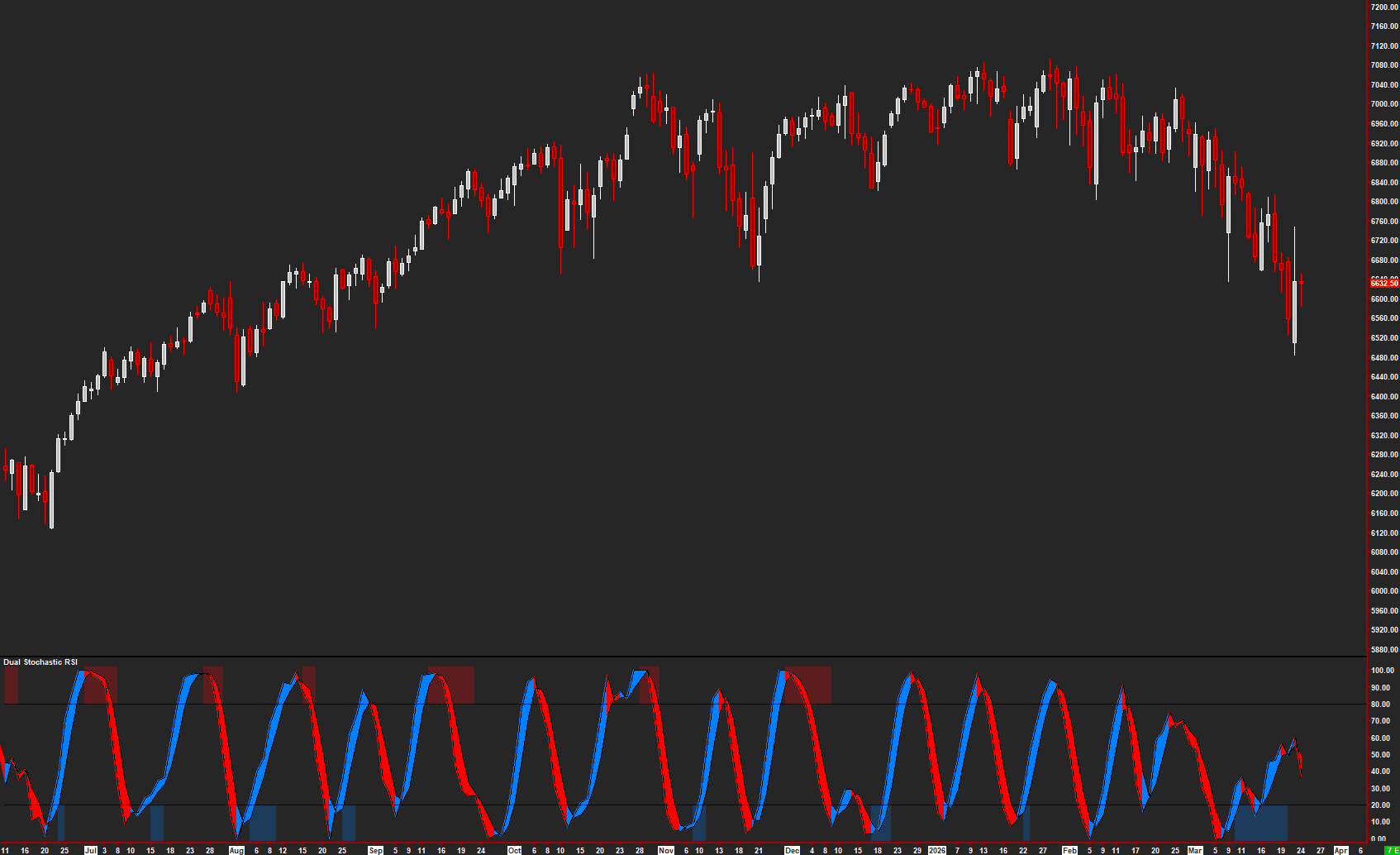
The Concept
This study layers two Stochastic RSI oscillators with independently configurable parameters to capture momentum at two different speeds simultaneously. The faster stochastic catches short-term turning points while the slower one confirms the broader momentum trend. Filled zones between the lines make it easy to spot when both timeframes agree.
How to Read It
Two sets of %K/%D lines oscillate between overbought and oversold zones.
- Both oscillators in overbought territory confirms strong bullish momentum
- Both oscillators in oversold territory confirms strong bearish momentum
- The faster oscillator crossing its signal line provides early timing signals
- When the fast oscillator diverges from the slow, momentum may be shifting
Practical Tips
Display in a separate chart region. The overbought/oversold thresholds define the zones — standard values work for most instruments. The dual approach lets you combine a fast oscillator for entry timing with a slower one for directional bias. Study subgraph references allow linking to external data for cross-market analysis.
Requirements
- Can only be used on charts with a chart data type of 'Intraday Chart'
- Recommended 'Intraday Data Storage Time Unit' setting '1 Tick'
Input & Settings
| No. | Input Name | Function |
|---|---|---|
| 1 | RSI: Input Data | The data used to calculate the RSI. |
| 2 | RSI: Length | The length for calculating the RSI. |
| 3 | RSI: Average Type | The type of moving average used for RSI. |
| 4 | Stochastic: %K Period | The period for the %K line in the Stochastic oscillator. |
| 5 | Stochastic: %D Period | The period for the %D line in the Stochastic oscillator. |
| 6 | Stochastic: Slowing Period | The period used for slowing in the Stochastic oscillator. |
| 7 | Stochastic: Average Type | The type of moving average used in the Stochastic oscillator. |
| 8 | Over Bought Line Value | The threshold value for determining overbought conditions. |
| 9 | Over Sold Line Value | The threshold value for determining oversold conditions. |
| 10 | RSI: Input Data 2 | The data used to calculate the second RSI. |
| 11 | RSI: Length 2 | The length for calculating the second RSI. |
| 12 | RSI: Average Type 2 | The type of moving average used for the second RSI. |
| 13 | Stochastic: %K Period 2 | The period for the %K line in the second Stochastic oscillator. |
| 14 | Stochastic: %D Period 2 | The period for the %D line in the second Stochastic oscillator. |
| 15 | Stochastic: Slowing Period 2 | The period used for slowing in the second Stochastic oscillator. |
| 16 | Stochastic: Average Type 2 | The type of moving average used in the second Stochastic oscillator. |
| 17 | Study Subgraph Reference | Refers to a study and subgraph index for referencing data. |
| 18 | Oversold Study Subgraph Reference | Refers to a study and subgraph index for referencing oversold data. |
The data used to calculate the RSI.
The length for calculating the RSI.
The type of moving average used for RSI.
The period for the %K line in the Stochastic oscillator.
The period for the %D line in the Stochastic oscillator.
The period used for slowing in the Stochastic oscillator.
The type of moving average used in the Stochastic oscillator.
The threshold value for determining overbought conditions.
The threshold value for determining oversold conditions.
The data used to calculate the second RSI.
The length for calculating the second RSI.
The type of moving average used for the second RSI.
The period for the %K line in the second Stochastic oscillator.
The period for the %D line in the second Stochastic oscillator.
The period used for slowing in the second Stochastic oscillator.
The type of moving average used in the second Stochastic oscillator.
Refers to a study and subgraph index for referencing data.
Refers to a study and subgraph index for referencing oversold data.
Subgraphs
| No. | Subgraph Name | Function & Comments |
|---|---|---|
| 1 | Background Fill | Default: Transparent Fill Top. Highlights the area above the OverBought line, emphasizing regions where the asset is potentially overbought. |
| 2 | Background Fill Undersold | Default: Transparent Fill Bottom. Highlights the area below the OverSold line, emphasizing regions where the asset is potentially oversold. |
| 3 | FullK | Default: Fill Top. Represents the %K line for the Stochastic RSI set. A fast-moving indicator that reflects current market momentum. |
| 4 | FullD | Default: Fill Bottom. Represents the %D line, a moving average of the %K line. Slower-moving, used to confirm signals given by FullK. |
| 5 | Over Bought | Default: Line Extended to Edge. Marks the overbought threshold level based on the input setting. |
| 6 | Over Sold | Default: Line Extended to Edge. Represents the oversold threshold level. |
| 7 | FullK Border | Default: Line. Settings for the visual appearance of the FullK border. |
| 8 | FullD Border | Default: Line. Settings for the visual appearance of the FullD border. |
Default: Transparent Fill Top. Highlights the area above the OverBought line, emphasizing regions where the asset is potentially overbought.
Default: Transparent Fill Bottom. Highlights the area below the OverSold line, emphasizing regions where the asset is potentially oversold.
Default: Fill Top. Represents the %K line for the Stochastic RSI set. A fast-moving indicator that reflects current market momentum.
Default: Fill Bottom. Represents the %D line, a moving average of the %K line. Slower-moving, used to confirm signals given by FullK.
Default: Line Extended to Edge. Marks the overbought threshold level based on the input setting.
Default: Line Extended to Edge. Represents the oversold threshold level.
Default: Line. Settings for the visual appearance of the FullK border.
Default: Line. Settings for the visual appearance of the FullD border.
Get Access to Every Study
All studies are included with the Gold License — proprietary Sierra Chart tools, Discord community access, and the full AMT framework.
Get the Gold License — $125/mo