Kairi Relative Index
Measures percentage deviation of price from its moving average
A Japanese technical indicator that measures the percentage deviation of the current price from its simple moving average. When the deviation is extreme, it signals that price may revert to the mean — useful for identifying overbought and oversold conditions.
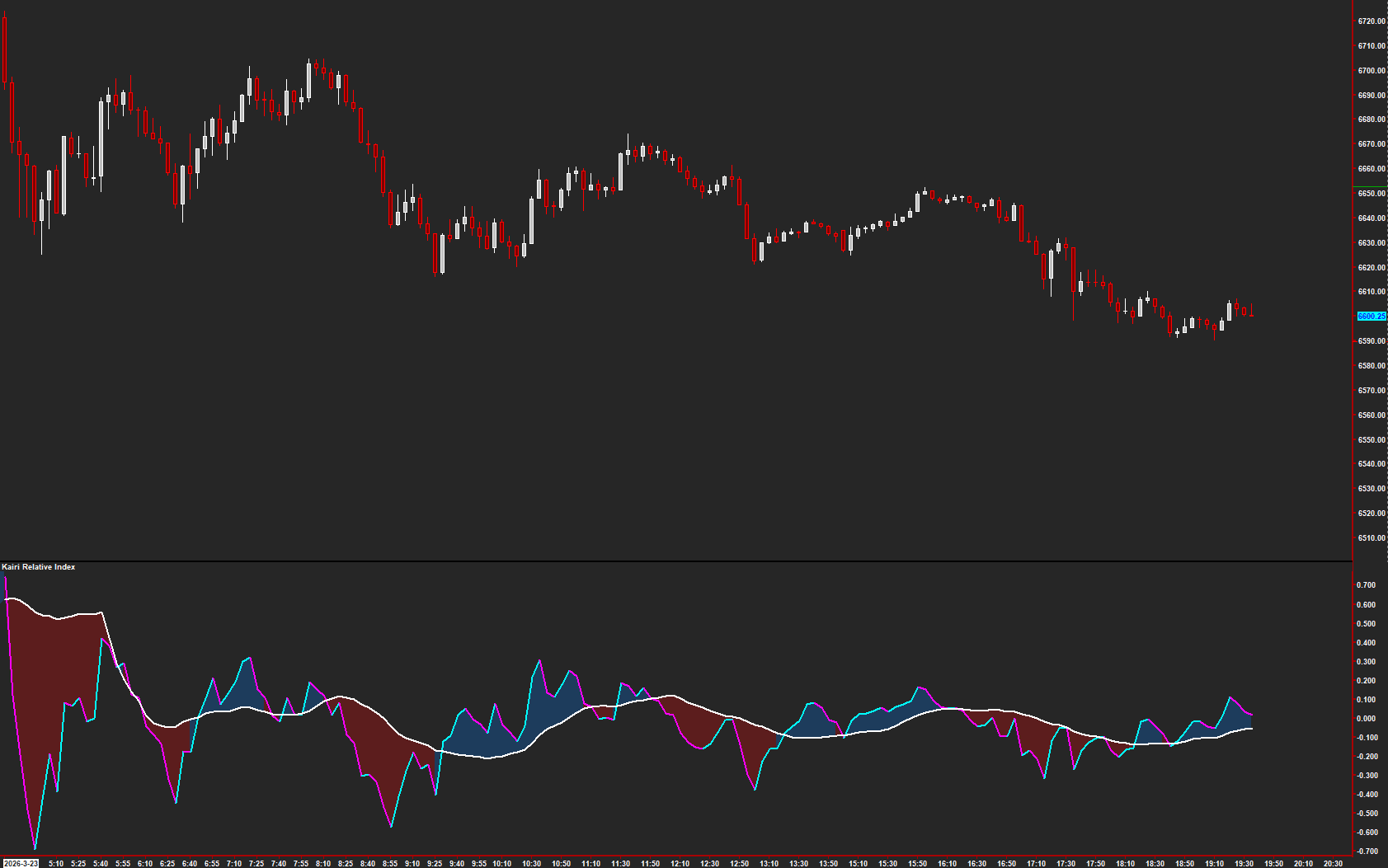
The Concept
The Kairi Relative Index measures how far price has deviated from its moving average, expressed as a percentage. When price stretches too far above or below the average, mean-reversion pressure builds. This Japanese indicator provides a clean, intuitive read on overbought and oversold conditions relative to a price baseline.
How to Read It
The Kairi line oscillates around zero in a separate chart region with color fills.
- Positive values (bear fill above) indicate price is extended above its average — overbought territory
- Negative values (bull fill below) indicate price is extended below its average — oversold territory
- The Final MA line acts as a signal line — crossovers provide timing for mean-reversion entries
- Slope color changes (cyan rising, magenta falling) highlight momentum direction shifts
Practical Tips
Display in a separate chart region. The SMA Period defines the baseline — shorter periods create a faster oscillator, longer periods catch larger deviations. The Final MA Period smooths the output for crossover signals. Kairi works well alongside trend studies: trade mean-reversion only in the direction of the larger trend.
Input & Settings
| No. | Input Name | Function |
|---|---|---|
| 1 | Input Data | Selects the price data used for the calculation. Default: Last/Close. |
| 2 | SMA Period | The period for the Simple Moving Average used as the baseline. Min: 1. Default: 10. |
| 3 | Final MA Period | The period for a secondary moving average applied to the Kairi output for smoothing. Min: 1. Default: 20. |
Selects the price data used for the calculation. Default: Last/Close.
The period for the Simple Moving Average used as the baseline. Min: 1. Default: 10.
The period for a secondary moving average applied to the Kairi output for smoothing. Min: 1. Default: 20.
Subgraphs
| No. | Subgraph Name | Function & Comments |
|---|---|---|
| 1 | Kairi Index Bull | Default: Transparent Fill Bottom. Fills the area below the Kairi line to highlight bullish (oversold) deviation zones. |
| 2 | Kairi Index | Default: Line. The primary Kairi Relative Index line, auto-colored by slope — cyan when rising, magenta when falling. |
| 3 | Kairi Index Bear | Default: Transparent Fill Top. Fills the area above the Kairi line to highlight bearish (overbought) deviation zones. |
| 4 | Final MA | Default: Line. A smoothed moving average of the Kairi Index, useful as a signal line for crossover analysis. |
Default: Transparent Fill Bottom. Fills the area below the Kairi line to highlight bullish (oversold) deviation zones.
Default: Line. The primary Kairi Relative Index line, auto-colored by slope — cyan when rising, magenta when falling.
Default: Transparent Fill Top. Fills the area above the Kairi line to highlight bearish (overbought) deviation zones.
Default: Line. A smoothed moving average of the Kairi Index, useful as a signal line for crossover analysis.
Get Access to Every Study
All studies are included with the Gold License — proprietary Sierra Chart tools, Discord community access, and the full AMT framework.
Get the Gold License — $125/mo