
TRADINGVIEW · Explore reach and reaction
AMT Zone Expectation
for TradingView.
Place ES and NQ in a six-zone session map with embedded historical reach rates, reaction rates, and sample counts.
See the published script for current access information. Platform subscriptions and data requirements are separate.
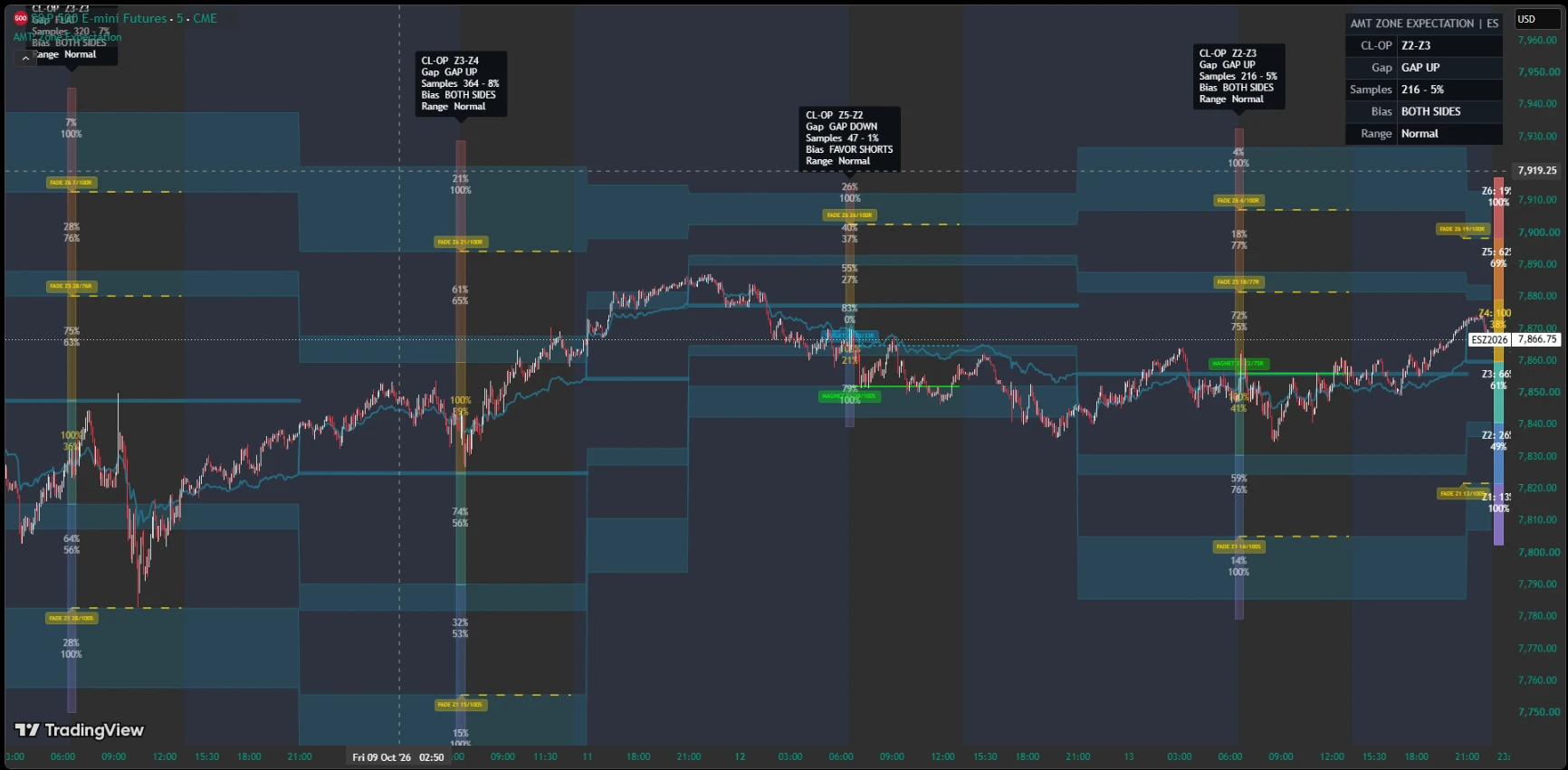
Select the historical context
CL is the prior regular-session close classified against that session’s zones. OP uses the preceding chart bar’s close at the detected regular-session open, classified against current zones. OP can therefore differ from the opening bar’s actual open. GAP UP, GAP DOWN, and FLAT compare zone numbers, not a point-sized price gap.
Read reach separately from reaction
The pole’s first line is historical zone reach. Its second line is support for Z1–Z3 or resistance for Z4–Z6. Magnet, Fade, and Target labels organize these readings with adjustable thresholds. Neither reach nor reaction is a trade win rate, and the script does not model profitability.
Session timing and saved history
Levels follow a 9 PM America/Los_Angeles reset with separate Sunday handling. Regular-session detection uses 8:30 AM–3 PM in the supported symbols’ exchange time zone. Historical poles and summaries are created when the session close is detected and drawn back at the saved opening bar. Their placement does not mean they appeared there live.
Set up the chart
Use standard intraday candles with overnight data and enough history to observe resets and session transitions. ES/MES use ES references; NQ/MNQ use NQ references. Other instruments are unsupported. Outside RTH, current price supplies a provisional OP; pole percentages are withheld by default until the next observed reset. Developing projections are not forecasts.