
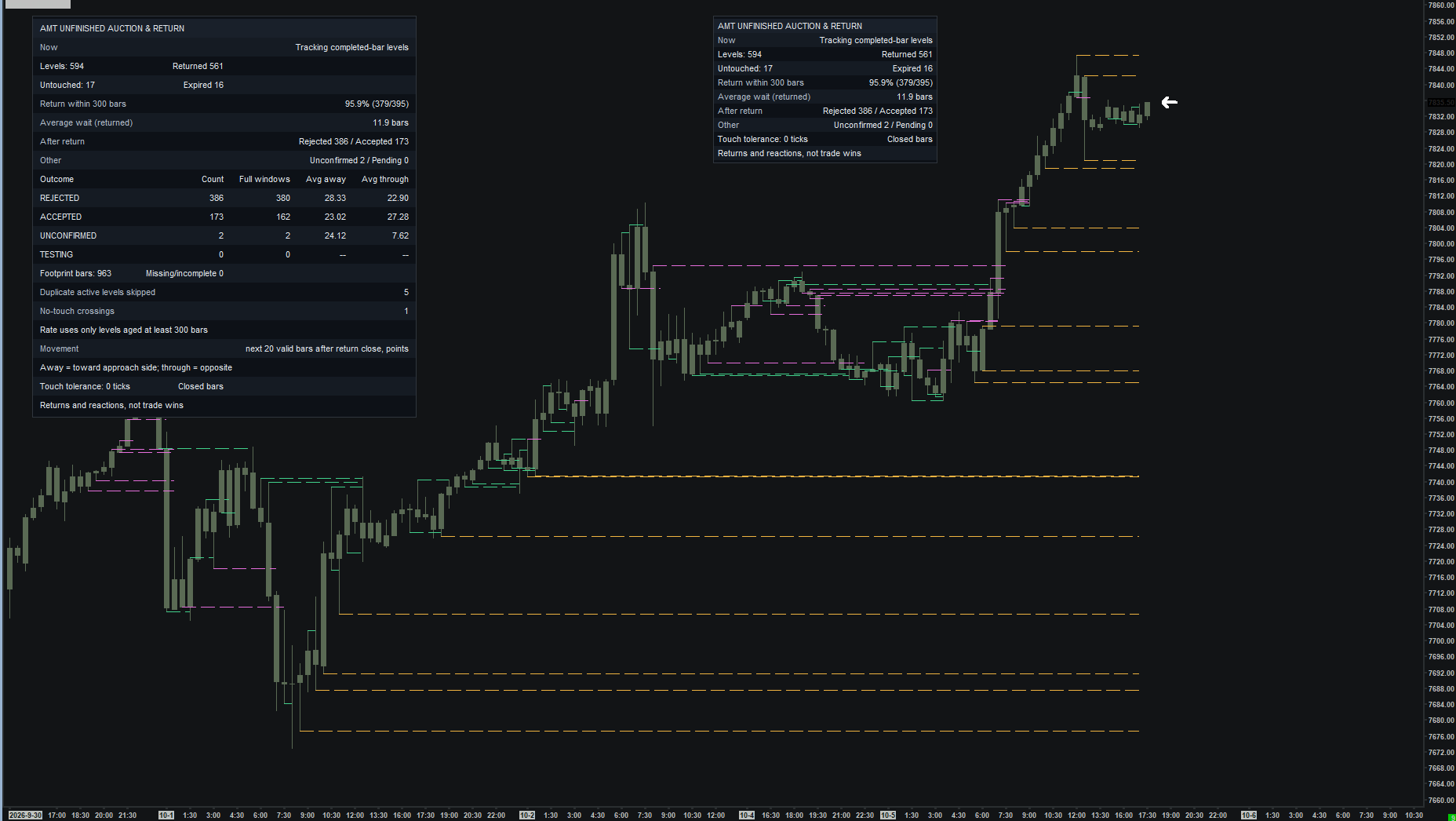
 Open full-size chart ↗
Review the history. Keep your chart clean.
The detailed tables and historical labels help you verify, study, and learn how price reacted. Compact and detailed views are shown together here for comparison. Use the study display settings to show or hide supported after-reaction details; once familiar with the levels, keep your live trading chart as clean as you prefer. Historical observations are not trade win rates.
Beyond the free Toolkit
What this adds to Unfinished Auction
In the free Toolkit
Marks completed-bar highs and lows where bid and ask volume meet the per-side minimum.
In paid Order Flow
Tracks departure, first return, rejection or acceptance through the level, and historical return observations.
See whether the marked level was revisited and what happened when price came back.
Explore the free Unfinished Auction study →What it shows
An unfinished high or low has bid and ask volume at the extreme, subject to minimum-volume filters. The study tracks departure, first actual return, rejection, and acceptance through the level.
How to read it
- Treat the extreme as an observation to track. Price is not required to return.
- The required departure must occur before a later touch counts as a first return.
- After return, distinguish rejection away from acceptance through using the configured close sequence.
Settings that matter
Minimum volume on each side, departure distance, touch tolerance, maximum bars to return, reaction window, and consecutive acceptance closes define the lifecycle.
Example sequence
A bar leaves both bid and ask volume at its high. Price moves away, revisits it, and then either rejects the level or accepts through it under the study's rules.
What to keep in mind
An unfinished auction is not a guaranteed target. Return counts depend on the allowed window and loaded history. Requires volume-at-price data.